First Milton, Now Rose
Rose Friedman has passed away.. Rest in peace.
Don't listen to the crowd, they say "jump."
Rose Friedman has passed away.. Rest in peace.
John Mackey, CEO of Whole Foods, posts The Whole Foods Alternative to ObamaCare at the WSJ.
The 8 things he lists are:
- Remove the legal obstacles that slow the creation of high-deductible health insurance plans and health savings accounts (HSAs).
- Equalize the tax laws so that employer-provided health insurance and individually owned health insurance have the same tax benefits.
- Repeal all state laws which prevent insurance companies from competing across state lines.
- Repeal government mandates regarding what insurance companies must cover.
- Enact tort reform to end the ruinous lawsuits that force doctors to pay insurance costs of hundreds of thousands of dollars per year.
- Make costs transparent so that consumers understand what health-care treatments cost.
- Enact Medicare reform.
- Finally, revise tax forms to make it easier for individuals to make a voluntary, tax-deductible donation to help the millions of people who have no insurance and aren't covered by Medicare, Medicaid or the State Children's Health Insurance Program.
Go read the whole thing; below, I have some notes of my own.
Point 1 (HSAs) is near and dear to me; I have an HSA and it's great. I get to keep all the money I don't spend; it's mine all mine. That makes me very cost-conscious, and I could be even more cost-conscious if point 6 (cost transparency) was available.
Points 2 (federal tax law), 3 (state law), and 4 (mandated coverage) should be educational to anyone who thinks we already have a free market in health care. We don't. These point out only a few of the kinds of federal and state regulation that reduce the effectiveness of markets.
Not sure how I feel about point 5 (tort reform). I'm definitely in favor of the reform that says "loser pays" but I'm betting that's not what most of the tort reform crowd has in mind.
Point 7 (Medicare reform) is a little vague.
Point 8 (donations to those without insurance) makes for actual *charity*, with all the moral and emotional benefits that confers upon the charitable giver, and not merely confiscation by the government.
Speaking of Obama's scare tactics, that 46 million is a very dubious statistic, the kind Mark Twain had in mind when he talked about lies and damned lies. Here's a chart from a GOP Senator (based on U.S. Census data) that explains who those 46 million actually are.
...
So what we actually have is about 12 million American citizens of income less than $75K who have no access to insurance or government programs. That's about 4% of the population. Many of those are young, healthy people who don't particularly need insurance, and those at incomes of $40-$50K or above can probably afford to borrow and repay medical bills over time; half seems a reasonable estimate of the two combined. So we have 2% of the country that really has a need for this reform.
via Classical Values :: Who's Afraid Of The Big Bad Health Care Crisis?.
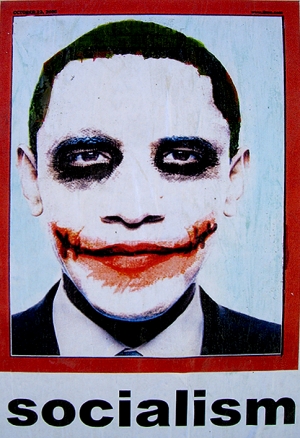
via http://newsbusters.org/blogs/noel-sheppard/2009/08/01/obama-joker-poster-popping-los-angeles.
File this under "dissent is the highest form of patriotism." ;-)
UPDATE (Mon 07 Aug):
âWant to know where I got these cars?â
When every benefit is received as a right, there is no place for good manners, let alone gratitude.
...
In the welfare state, mere survival is not the achievement that it is, say, in the cities of Africa, and therefore it cannot confer the self-respect that is the precondition of self-improvement.
...
...a system of welfare that makes no moral judgments in allocating economic rewards promotes antisocial egotism.
Apollo was not a methodical space program; it was an anomalous race in the Cold War in which anything could be wasted but time. It turned out to be unsustainable and unaffordable, which is why it boggles the mind that over three decades later--during which time there were huge technology advances--Apollo was chosen as a model for a program that was supposed to be affordable and sustainable.
The shuttle program didnât demonstrate that reusable vehicles donât work. In fact, the one reusable part of the shuttle--the airplane-like orbiter--was the only part that didnât kill crew (the solid rocket booster was responsible for the Challenger accident, and the external fuel tankâs foam was responsible for the Columbia accident). Moreover, the shuttle program tells us nothing at all about reusable space transports that are designed to reasonable requirements and high flight rates--particularly fully reusable ones that donât shed hardware each flight.
Neither does the shuttle experience prove that we shouldnât mix crew and cargo. All it tells us is that if we are going to build a reusable vehicle, it has to be sufficiently reliable to safely carry either crew or valuable cargo (just as airplanes are), because space transports cost too much to lose, regardless of their payloads. When Columbia was lost, we lost seven astronauts, yes. But we also lost a quarter of our orbiters. That is simply unaffordable. Cheap bulk cargo could reasonably be launched on less expensive, less reliable vehicles, but when we do develop practical space transports, the notion of throwing rockets away will make no more sense than burning a 747 on the runway after it lands with a load of cut flowers.
Likewise, the space station doesnât teach that we must avoid assembling things in orbit; if anything, it shows that orbital assembly can be very effective when building something large out of many smaller pieces. That it took so long and cost so much is attributable to the constraints of the shuttle (and of the co-opting of the station for diplomatic ends). For that matter, the several repairs to the Hubble Space Telescope, various satellite repair missions, and the first Skylab mission back in 1973 show how even complicated and dangerous repair and servicing operations can be successfully conducted in orbit.
It's crazy for a group of mere mortals to try to design 15 percent of the U.S. economy. It's even crazier to do it by August.
Yet that is what some members of Congress presume to do. They intend, as the New York Times puts it, "to reinvent the nation's health care system."
Let that sink in. A handful of people who probably never even ran a small business actually think they can reinvent the health care system.
Politicians and bureaucrats clearly have no idea how complicated markets are. Every day people make countless tradeoffs, in all areas of life, based on subjective value judgments and personal information as they delicately balance their interests, needs and wants. Who is in a better position than they to tailor those choices to best serve their purposes? Yet the politicians believe they can plan the medical market the way you plan a birthday party.
I think it is fair to conclude from this that the Massachusetts health reform plan, which in some ways is the model for the plans currently under discussion in Congress, was a failure. Thanks to Mark Ambinder for the pointer.
Maybe the commission's proposal is a step in the right direction. Even if it is, I would suggest that perhaps no expert knows how to design the health care system. We may need a lot of trial and error. Government takeover means that you try something new every few years...maybe. Your choices are limited because entrenched interests preclude many options.
With markets, trial and error takes place continuously. A lot more things get tried. Failure gets weeded out more ruthlessly.
via Massachusetts Health Reform, Version 2.0?, Arnold Kling | EconLog | Library of Economics and Liberty.
According to the chap who runs the Massachussetts exchange, the state and medical providers still face a hefty expense for treating those who don't have insurance, with over half the cost of medical care for the uninsured still persisting. And the new system is very expensive, particularly in a time of fiscal trouble.
It's thus predictible that a commission appointed by the governor wants to move in a new direction: capitation. That's when the state pays providers a fixed amount for each person (in the plan, or in their practice) and lets the providers figure out how to treat them.
Capitation looks attractive, because it discourages doctors and hospitals from doing too much. But, as with all good things in life, it has a few downsides ...
I don't like a system where the doctor has a financial incentive to give me unnecessary tests. But I'm even less fond of the idea of giving her financial incentives not to give me necessary ones.
via Massachussetts Health Plan Pushes for Capitation - Megan McArdle.
I take Lipitor. The drug may extend my life. But this doesn't lower my health-care costs. Years of pill-taking increases costs. If the pill works, I may live long enough to get an even more expensive disease. And maybe I, like millions of others, take Lipitor unnecessarily because we would never have had heart attacks. We then spend more, not less, on health care.
Health-care expert John Goodman of the National Center for Policy Analysis says there are "literally hundreds of studies from over the past 40 years that show preventive medical services usually increase medical spending ... Contrary to popular belief, checkups for children and adults do not save the health care system money."
If the policy elite really wanted cost-cutting competition, they would deregulate medicine. No one has ever found a better way to stimulate competition than freedom.